How to Complete the ECDD Form for Singapore Compliance
A comprehensive section-by-section guide with visual sample illustrations for preparing, completing, and submitting the Enhanced Customer Due Diligence (ECDD) form in full accordance with Singapore's Corporate Service Providers Act 2024 and ACRA regulatory requirements.
Prepared by VietCham Singapore Compliance Team · Updated August 2026
Purpose of the ECDD Form
The Enhanced Customer Due Diligence (ECDD) form is required to verify client identity, trace the legitimate origins of wealth and capital, and establish clear operational context in accordance with Singapore's anti-money laundering (AML) and countering the financing of terrorism (CFT) framework.
Vietnam Chamber of Commerce Pte. Ltd. is a Registered Corporate Service Provider and ACRA Filing Agent (FA20240453). Under Section 17 of the Corporate Service Providers Act 2024 (CSPA 2024), we are legally mandated to conduct due diligence on every client and demonstrate to ACRA that the level of scrutiny is proportionate to each profile's risk factors. This statutory obligation cannot be waived or compromised.
Legal Basis & Key Applicable Clauses
Our compliance procedures directly follow the statutory framework administered by ACRA:
Enhanced due diligence is triggered by objective structural factors — such as foreign directors/shareholders, nominee director appointments, registered address services, or specific business sectors (Appendix B of ACRA Guidelines). Additionally, Vietnam is on the FATF Increased Monitoring List (updated 19 June 2026), which is a risk factor we are statutory required to evaluate. This is standard procedure and not a reflection of personal suspicion.
Each beneficial owner must complete and sign their own section individually. One shareholder cannot declare on behalf of another without a formal board resolution or certified power of attorney. For individuals residing outside Singapore, identity document copies must be certified by a notary public, Commissioner for Oaths, or practising solicitor.
All provided information is utilized strictly for statutory AML/CFT compliance. It is safeguarded under the Personal Data Protection Act 2012 (PDPA), retained securely for 5 years pursuant to Section 17(5) of CSPA 2024, and disclosed only when mandated by Singapore law.
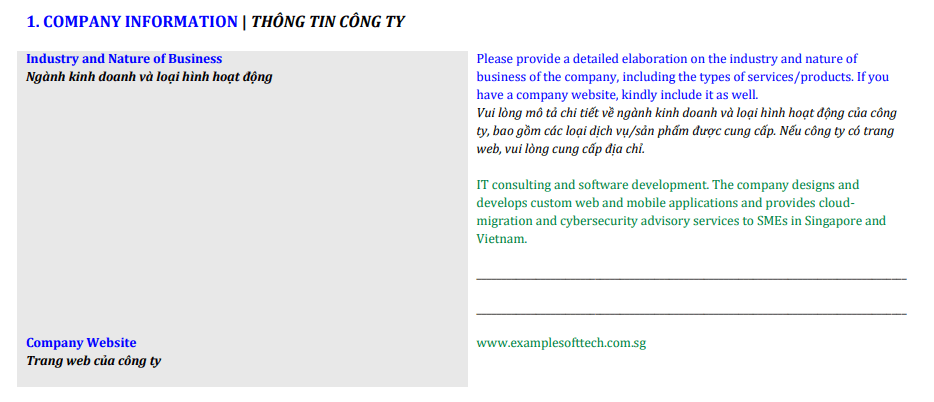
Business Activity & Operational Type
Paragraph 6.44(a) of the ACRA Guidelines requires corporate service providers to understand the business context and legitimate operational purpose of the client entity. Please provide a clear and thorough description of your company's activities.
- Business Activity & Types of Operations
Provide a comprehensive description of the products or services offered, targeted markets, and commercial operations.
Example: IT consulting, cloud infrastructure, and software development. The company designs custom enterprise applications for clients in Southeast Asia. - Company Website (URL)
If the company maintains an active public website or online presence, provide the complete URL. If the company is newly incorporated or pre-operational, specify "Not applicable".
Identification Documents
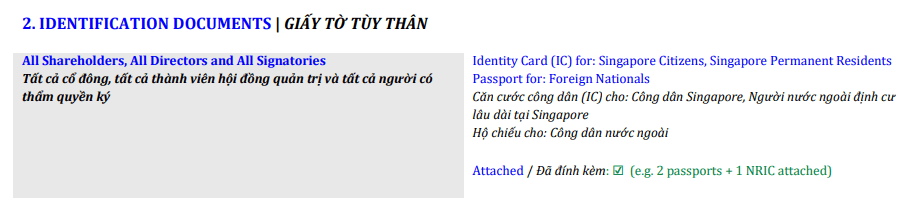
This section applies to all shareholders, all board directors, and all authorised bank account signatories of the entity.
- Singapore Citizens & Permanent Residents (PR)
Provide a clear, high-resolution colour scan of your Singapore Identity Card (NRIC / IC) — both front and back sides.
- Foreign Nationals (e.g., Vietnamese Passport Holders)
Provide a high-resolution colour scan of your valid international passport (the complete bio-data page, uncropped, glare-free, with MRZ lines fully legible).
For individuals residing outside Singapore, copies of all identity documents must be certified as true copies by an authorised professional: a registered Notary Public, Commissioner for Oaths, or practising solicitor.
Work History & Track Record
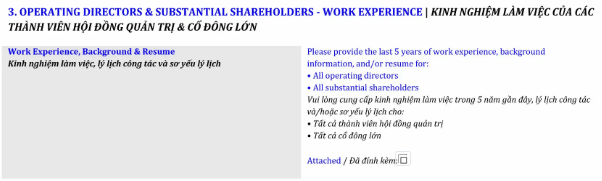
Under Paragraph 6.44(a) of the ACRA Guidelines, filing agents must evaluate the commercial background and competence of the leadership team. You do not need to create a new formal document — existing professional résumés, CVs, or LinkedIn profiles are fully acceptable.
Please submit the past 5 years of employment or business history, including past companies, positions held, industry sector, and professional qualifications for all directors and all major shareholders.
Related Business Activities
Declare whether any foreign director or shareholder currently owns, directs, or holds substantial interests in other business entities or related companies in Singapore operating in the same or complementary industry.
- If Yes (Related Entities Exist)
Provide the registered Company Name, UEN (Unique Entity Number), and Website URL for each affiliated entity.
- If No (No Related Entities)
Explicitly write "Not applicable" or "None".

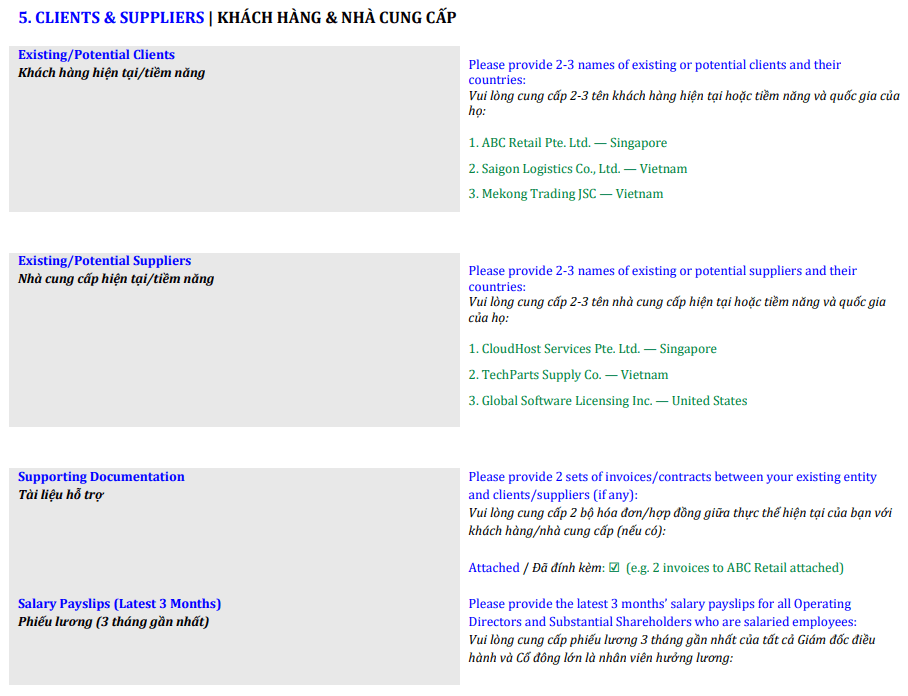
Clients & Suppliers
Providing details on your commercial counter-parties demonstrates genuine economic substance and bona fide business activity.
- Current or Prospective Clients
List 2 to 3 major client names along with their country of domicile or operations.
- Current or Prospective Suppliers
List 2 to 3 major supplier/vendor names along with their country of operation.
- Commercial Supporting Documentation
Attach 2 sample sets of commercial contracts, purchase orders, or invoices with counter-parties (if currently active).
- Salary Payslips
Provide the 3 most recent monthly payslips for all executive directors and major shareholders who receive employee remuneration.
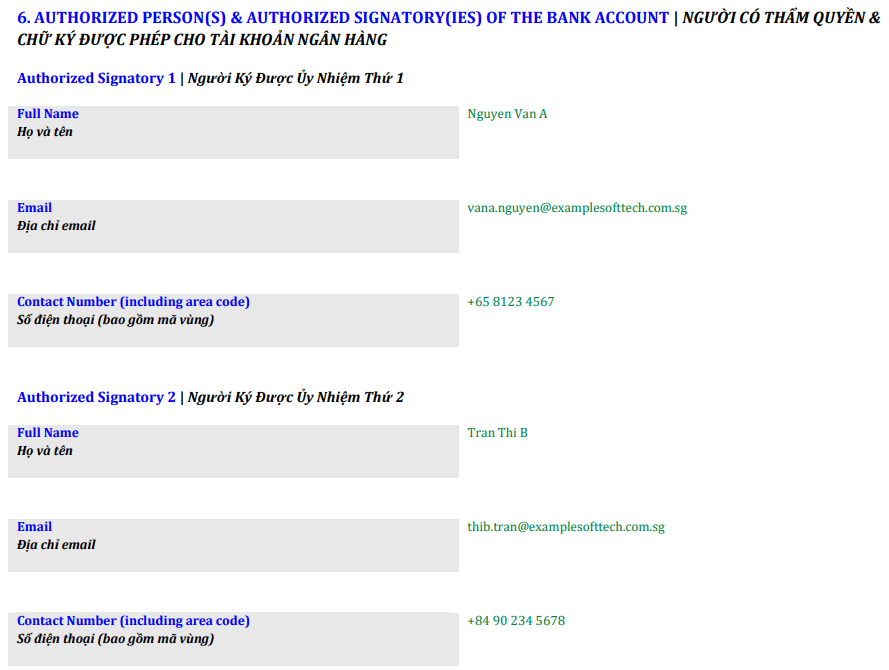
Authorised Bank Account Signatories
Identify every person authorized to operate the company's corporate bank account(s) or initiate financial transfers:
- Full Legal Name
Exactly as displayed on the individual's government passport or national identity card.
- Official Email Address
Primary business or personal email utilized for official bank communications.
- Direct Contact Number with Country Code
Include the international dialing prefix.
Examples: +84 90 123 4567 (Vietnam) or +65 8123 4567 (Singapore).
Source of Wealth & Source of Funds
Paragraph 6.44(c) of the ACRA Guidelines mandates that filing agents establish both the source of overall wealth and the specific source of funds deployed in the entity. Appendix C, Section D requires that each beneficial owner complete and sign this declaration independently.
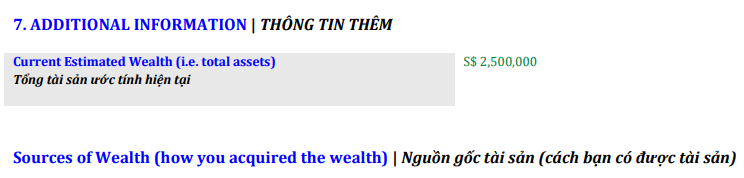
- Current Estimated Total Net Worth
State an approximation of your total accumulated personal net worth (denominated in SGD equivalent).
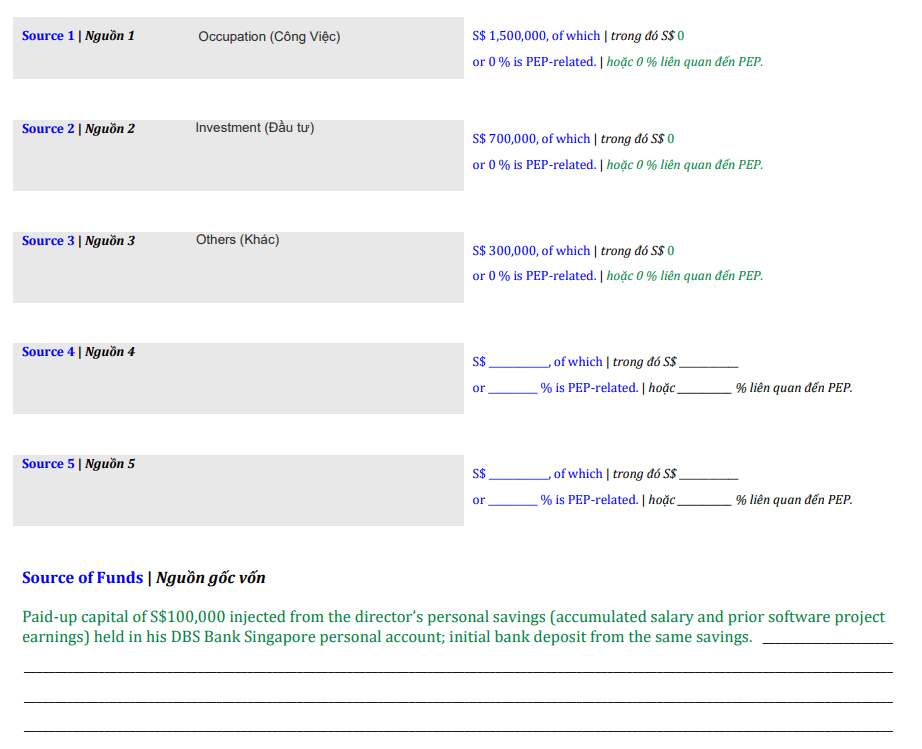
- Sources of Accumulated Wealth
Itemize each contributing source, its estimated monetary contribution, and disclose whether any portion is connected to a Politically Exposed Person (PEP). Consult the documentation guide below.
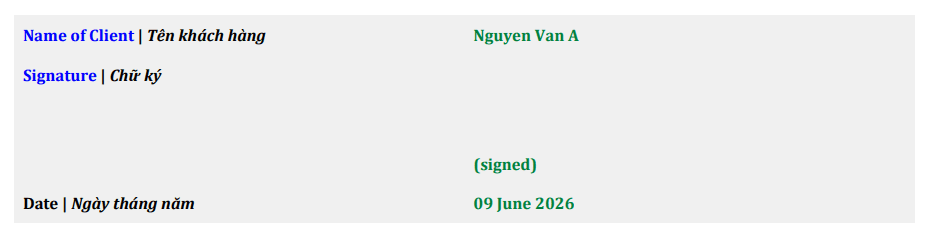
- Source of Funds for This Specific Company
Explain the exact source of capital injected into this entity.
Example: Paid-up capital of SGD 50,000 transferred from the founder's personal bank savings derived from past software executive salary.
Finally, each declaring beneficial owner must provide their full legal name, formal handwritten or qualified digital signature, and date of execution. By signing, you certify that all statements made are true and accurate, and authorize VietCham Singapore to conduct verification checks as mandated by ACRA.
Visual Sample Guides for Section 07 (Parts 1–4)

Glossary of Key Terms
- PEP (Politically Exposed Person)
- An individual currently or formerly entrusted with prominent public functions — such as heads of state or government, senior politicians, senior judicial or military officials, senior executives of state-owned enterprises, or high-ranking political party figures. Immediate family members and close associates are also deemed PEP-related.
- Source of Wealth
- The comprehensive economic background explaining a person's total accumulated net worth — how their overall fortune was accrued across their lifetime (e.g., career earnings, business dividends, investments, inheritances).
- Source of Funds
- The specific monetary origin of the assets deployed for this concrete transaction or commercial relationship — such as the paid-up capital contributed for company incorporation or bank account funding.
- Beneficial Owner
- An individual who ultimately owns or exerts effective control over the corporate entity — typically any natural person who, directly or indirectly, owns 25% or more of shares/voting rights or controls the assets of the company (pursuant to Regulation 21(4)(a) of the Corporate Service Providers Regulations 2025).
Common Questions About the ECDD Form
Detailed guidance regarding statutory obligations, signature requirements, privacy protections, and document standards.
Why is VietCham asking me to complete an ECDD form?
Vietnam Chamber of Commerce Pte. Ltd. is a Registered Corporate Service Provider and ACRA Filing Agent (FA20240453). Under Section 17 of the Corporate Service Providers Act 2024, we are legally required to conduct customer due diligence on every client and must demonstrate to ACRA that the level of scrutiny is proportionate to each client's risk profile. This statutory obligation cannot be waived or bypassed by agreement.
Does receiving an ECDD form mean I am suspected of wrongdoing?
No. Enhanced due diligence is triggered by objective structural characteristics outlined in Appendix B of ACRA Guidelines — such as directors or shareholders residing outside Singapore, the provision of registered office or nominee director services, or the company's designated industry sector. Furthermore, Vietnam is on the FATF Increased Monitoring List (updated 19 June 2026), which is a factor we are legally required to incorporate into our risk assessment. This is a standard regulatory procedure and does not reflect any personal suspicion.
Who must complete and sign the ECDD form?
Each beneficial owner must complete and sign their own section individually. One shareholder cannot declare on behalf of another unless backed by a formal board resolution or valid power of attorney. For individuals residing outside Singapore, identity document copies must be certified as true copies by a notary public, Commissioner for Oaths, or practising solicitor.
What is the difference between 'Source of Wealth' and 'Source of Funds'?
Source of Wealth refers to the economic origin of a person's total accumulated net worth — how they built their overall wealth over their lifetime (e.g., employment salary, business ownership, real estate, investments, inheritance). Source of Funds refers specifically to the origin of the capital or assets being utilized in this particular transaction — such as the paid-up capital transferred to incorporate the Singapore company.
Who qualifies as a Politically Exposed Person (PEP)?
A PEP is an individual who currently holds or has previously held a prominent public function: heads of state or government, senior politicians, senior government, judicial or military officials, senior executives of state-owned corporations, or important political party leaders. Immediate family members (spouses, children, parents, siblings) and close business associates are also classified as PEP-connected individuals.
How will my sensitive information and documents be protected?
All documentation submitted is handled with strict confidentiality solely for regulatory compliance purposes. It is protected under Singapore's Personal Data Protection Act 2012 (PDPA), stored securely with encryption, retained for a mandatory period of 5 years pursuant to Section 17(5) of the CSPA 2024, and disclosed only when mandated by Singapore law enforcement or regulatory authorities.
What happens if I fail or refuse to submit a completed ECDD form?
If the ECDD submission is incomplete or missing, VietCham cannot demonstrate statutory compliance to ACRA. Under Singapore law, we will be legally prohibited from providing or continuing corporate secretarial services, registered office facility, or nominee director appointments for your company.
Related Guides & Corporate Services
Read our KYC Document Guide, learn how to prepare monthly accounts in our Bookkeeping & Accounting Guide, explore the full Singapore Incorporation Procedure, view our Company Incorporation Services, or contact VietCham Singapore for personal assistance.
Need Assistance With Your ECDD Submission?
VietCham Singapore's compliance team will guide you through every section of the form in English or Vietnamese.